
Clear writing helps readers understand your ideas without unnecessary effort. However, even a good idea can become difficult to follow when sentences are too long, complicated, or filled with unnecessary words.
The good news is that you do not need to be a professional writer to improve your sentences. With a few simple techniques, you can make your writing clearer, more natural, and easier to read.
Here are seven practical tips you can start using today.
1. Keep One Main Idea per Sentence
One of the easiest ways to improve clarity is to give each sentence a clear purpose. When you try to explain too many things at once, readers may struggle to follow your point.
For example:
Less clear:
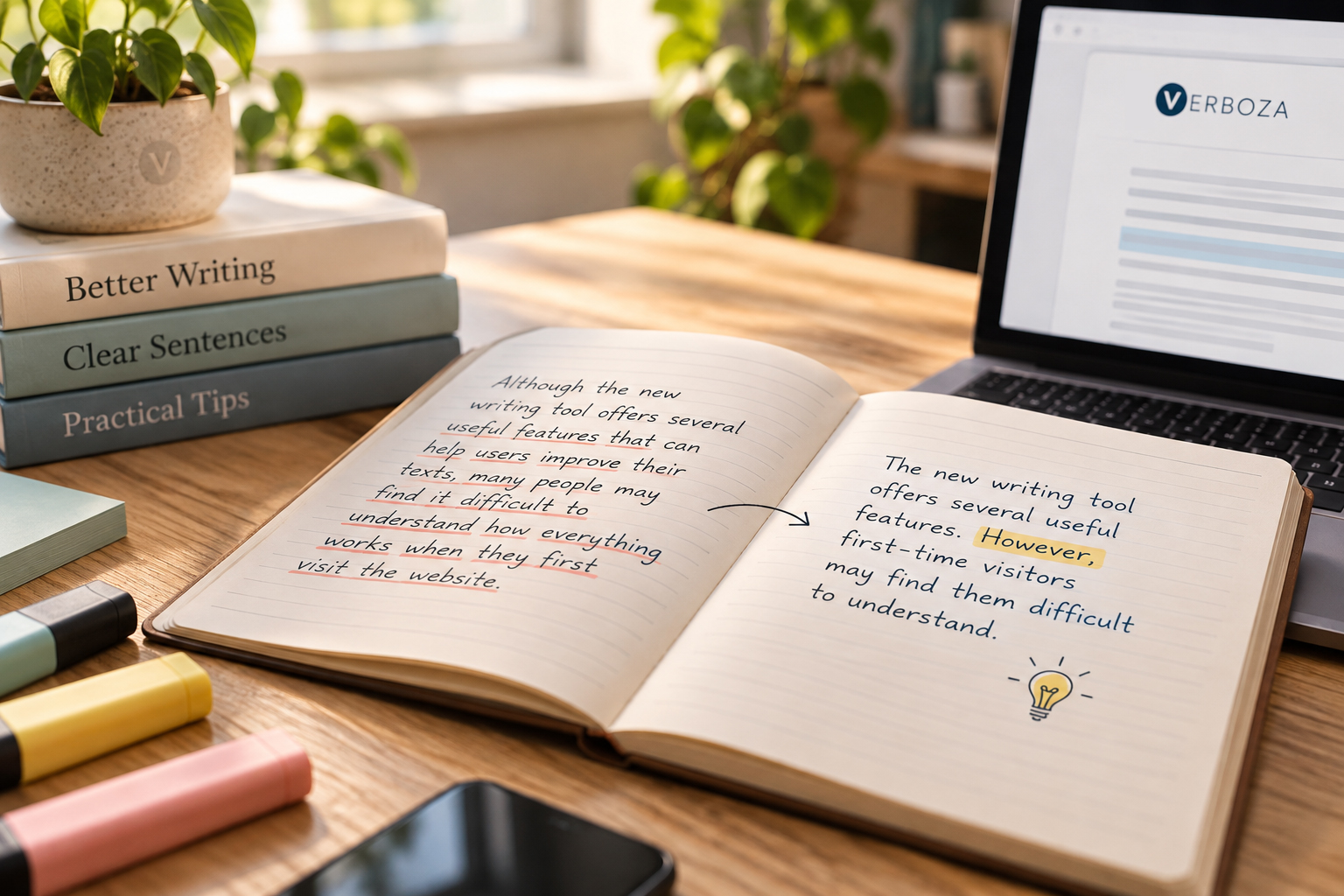
Although the new writing tool offers several useful features that can help users improve their texts, many people may find it difficult to understand how everything works when they first visit the website.
Clearer:
The new writing tool offers several useful features. However, first-time visitors may find them difficult to understand.
Notice how the second version separates the main ideas. As a result, the message becomes easier to follow.
2. Choose Simple, Familiar Words
Long or complicated words do not automatically make writing more professional. In fact, familiar words often communicate ideas more effectively.
For example, instead of writing “utilize,” you can usually write “use.” Similarly, “in order to” can often become “to.”
Of course, some technical terms are necessary. However, when a simpler word expresses the same meaning, it is usually the better choice.
Quick tip: After writing a sentence, look for words you could replace with simpler alternatives without changing the meaning.
3. Remove Unnecessary Words
Sometimes, the clearest improvement is simply to remove words.
For instance, phrases such as “at this point in time” can become “now.” Likewise, “due to the fact that” can usually become “because.”
These small changes make your sentences shorter and more direct. Moreover, they help readers focus on the information that matters.
Try reviewing each sentence and asking yourself: Does every word add something useful?
If not, remove it.
4. Use Active Voice When It Makes Sense
Active voice often makes sentences clearer because it tells readers who performs the action.
Compare these examples:
Passive:
The article was written by Sarah.
Active:
Sarah wrote the article.
The active version is shorter and more direct. It also makes the person responsible for the action immediately clear.
Nevertheless, passive voice is not always wrong. It can be useful when the action matters more than the person performing it. The goal is to choose the version that communicates your meaning most clearly.
5. Break Up Long Sentences
Long sentences are not necessarily bad. However, when several ideas compete for attention, readers can lose track of the main point.
If a sentence contains multiple clauses, explanations, and examples, consider splitting it into two or three shorter sentences.
For example:
Less clear:
You can improve your writing by reading your text carefully, checking for repeated words, removing unnecessary phrases, and making sure that each paragraph supports the main point you want to communicate.
Clearer:
You can improve your writing by reviewing it carefully. Remove repeated words and unnecessary phrases. Finally, make sure each paragraph supports your main point.
The revised version is easier to scan and understand. At the same time, it preserves the original message.
For another practical approach, read our guide to improving your writing, which covers several habits that can strengthen your overall writing.
6. Use Transition Words to Connect Ideas
Clear sentences need to work together, not just stand alone. Transition words help readers understand how one idea relates to the next.
For example:
- However introduces a contrast.
- Therefore shows a result.
- For example introduces an illustration.
- In addition adds another point.
- As a result explains a consequence.
- Meanwhile connects events happening at the same time.
- Finally signals the last point in a sequence.
Use these phrases when they make the relationship between ideas clearer. However, avoid adding them to every sentence simply to sound sophisticated.
A natural transition should help the reader, not slow them down.
7. Read Your Writing Out Loud
Finally, read your text aloud before publishing or sending it. This simple habit can reveal awkward phrasing, sentences that run on too long, and words that do not sound natural together.
If you run out of breath while reading a sentence, it may be worth shortening it. Similarly, if you stumble over a phrase, try rewriting it in a more conversational way.
You can also use Verboza’s free Readability Checker to help assess how easy your text is to read. For a quick review of sentence length, try the Sentence Counter.
These tools can provide useful feedback. Still, your own judgment matters: the best sentence is one that communicates your intended meaning to your reader.
Make Every Sentence Count
Writing clearer sentences does not mean making every sentence short or removing your personality from the text. Instead, it means choosing words carefully, organizing ideas logically, and giving readers a smooth path through your message.
Start with one or two of these techniques the next time you write. Then, review your text and look for opportunities to make it more direct and easier to understand.
With practice, clear writing becomes a habit.
Ready to improve your text? Explore Verboza’s free Word Counter, Sentence Counter, and Readability Checker to help you review your writing with confidence.